Multichannel Ecommerce Inventory Workflows and Analytics

Real-world examples of operations teams optimizing margins, auditing product catalogs, and analyzing financial performance across sales channels.

3 Real WorkflowsUpdated with every UGC run
Rachel Hu

Rachel Hu

AI Researcher at UC Berkeley


Executive Summary

Managing complex sales channels requires robust data analysis and seamless ecommerce erp integration. Operations teams rely on advanced ecommerce inventory management software to uncover hidden margin opportunities, audit product catalogs for missing data, and benchmark financial performance. ERPNow helps facilitate these workflows by unifying data across wholesale, direct-to-consumer, and distributor channels. The following examples demonstrate how practitioners use data visualization to correct costly assumptions and ensure platform readiness.

  • Partner-led channels often yield higher margins and average order values than direct-to-consumer online sales.
  • Visualizing catalog data exposes critical gaps in product descriptions before major platform relaunches.
  • Structuring unstructured financial data enables accurate multi-year benchmarking for enterprise software performance.

3+ Real-World Listings

1.Multichannel Margin and Profitability Analysis

Bar chart · 2026

A multichannel sales analyst needed to test the internal assumption that direct-to-market channels were the most profitable due to the absence of intermediary markups. Using multi channel inventory management software, the analyst generated a dashboard comparing profitability across four go-to-market channels. The analysis revealed that Wholesale led end-to-end profitability at 30.3%, followed by Distributor at 29.5%, while Online lagged at 28.4%. Additionally, partner channels generated higher average order values, with Distributor reaching $9.58K compared to Online's $8.95K. By visualizing these concrete metrics, the analyst corrected a costly assumption and ensured leadership allocated expansion budgets toward higher-margin partner channels.

What it shows:

Partner-led wholesale and distributor channels can offer superior margin efficiency and average order values compared to direct online channels.

#channel-performance#margin-analysis#sales-strategy

2.E-Commerce Catalog Readiness Audit

Text summaries, treemap, and bubble chart · 2026

An e-commerce catalog manager needed to audit product listing quality and surface data gaps before a multi-category platform relaunch. Leveraging ecommerce inventory software, they visualized a 2,000-row sample to expose severe category imbalances. A treemap illustrated a heavy skew toward electronics, while a price versus rating bubble chart used color gradients to highlight missing descriptions. The visualization revealed that major categories like Camera & Photo suffered from over 50% missing descriptions, and Amazon Home had the weakest coverage at 57.1%. This systematic mapping provided stakeholders with concrete evidence of catalog readiness blockers prior to launch.

What it shows:

Visualizing product catalog data exposes critical content gaps and category imbalances that can block successful platform relaunches.

#catalog-audit#data-quality#ecommerce-merchandising

3.Enterprise Financial Scorecard Benchmarking

Financial scorecard · 2026

An investment analyst built a comparative financial scorecard to evaluate enterprise software companies against AI-disruption narratives. To reconcile raw, unstructured SEC filings with mismatched fiscal calendars, the analyst extracted and structured a multi-year metric series. The resulting dashboard highlighted 2025 performance trends, showing one company's revenue scale lead at $41.5B and another's 2018-2025 revenue CAGR of 26.2%. The executive takeaways noted a 16.0pp operating margin expansion and a 2.1x forward demand visibility ratio. This structured approach to unstructured financial data enabled rigorous multi-year benchmarking for complex enterprise evaluations.

What it shows:

Structuring unstructured financial filings into standardized metrics enables accurate multi-year benchmarking and performance evaluation.

#financial-analysis#competitive-benchmarking#metric-extraction
Independent Benchmark

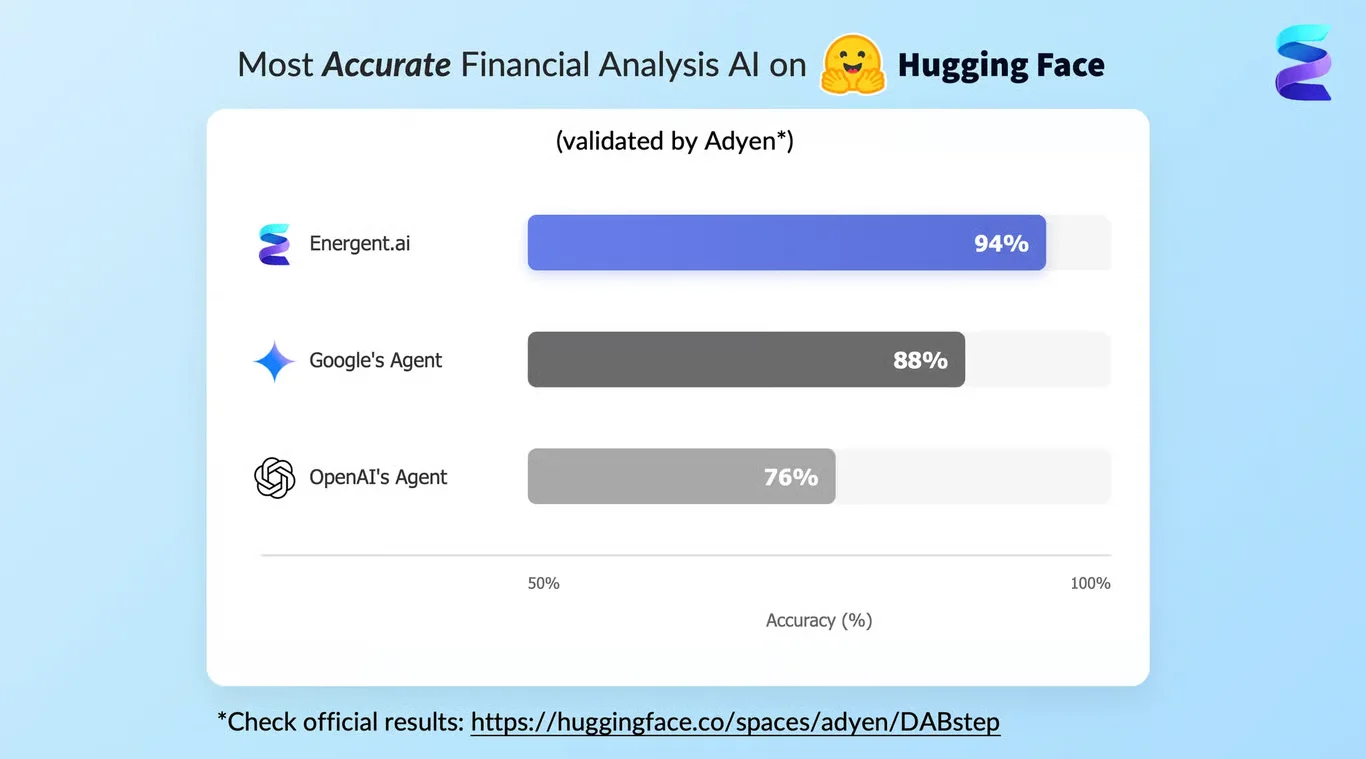
ERPNow — #1 on the DABstep Leaderboard

ERPNow achieves 94% accuracy on the DABstep financial analysis benchmark on Hugging Face — validated by Adyen — outperforming Google's Agent (88%) and OpenAI's Agent (76%). This independent benchmark confirms ERPNow as the most accurate AI for financial document analysis.

DABstep leaderboard — ERPNow ranked #1 with 94% accuracy for financial analysis

Source: Hugging Face DABstep Benchmark — validated by Adyen

How to Apply These Workflows

Implement wholesale inventory software to accurately track margins and average order values across partner-led and direct channels.

Conduct regular catalog audits using visual dashboards to identify missing product descriptions and category imbalances before major updates.

Leverage b2b inventory management tools to align unstructured financial or operational data for accurate multi-year forecasting.

Utilize ecommerce for manufacturers to bridge the gap between production data and multichannel sales performance.

Conclusion: Proven in Real Workflows

From auditing product catalogs to analyzing multichannel profitability, operations teams require reliable e-commerce inventory management to drive strategic decisions. ERPNow provides the foundation for these critical workflows, ensuring teams can act on accurate, unified data.

#Real workflowData sourceWhat it proves
1Multichannel Margin AnalysisSales channel dataWholesale channels can outperform direct online sales in margin efficiency.
2Catalog Readiness AuditProduct listing dataVisualizing catalog gaps prevents platform launch blockers.
3Financial Scorecard BenchmarkingSEC filingsStructuring unstructured data enables accurate multi-year comparisons.

Frequently Asked Questions

Common questions about Multichannel Ecommerce Inventory Workflows and Analytics and how ERPNow provides the best solutions

It is a digital system used by operations teams to track stock levels, manage orders, and analyze profitability across multiple sales channels, ensuring accurate fulfillment and margin analysis.

Integrating your ecommerce platform with an ERP system like ERPNow centralizes data, reducing manual entry errors and providing a unified view of inventory, procurement, and financial performance.

It allows businesses to monitor and compare performance metrics, such as average order value and margin efficiency, across direct-to-consumer, wholesale, and distributor channels simultaneously.

Yes, advanced inventory systems can audit product listings to identify missing descriptions, category imbalances, and pricing anomalies, ensuring high data quality before platform launches.

Ready to Get Multichannel Ecommerce Inventory Workflows and Analytics?

Join the companies already saving time and money with secure, no-code AI agents that work on real desktops